Monday, December 7, 2015

Computer - Cycle Test 3 - ITKT


Note :- 
for better exam preparation students are suggested  to refer textbook and work book along with this material.

Cycle Test - 3 - Computer Syllabus
Chapter - 4 - Introduction to HTML

Chapter - 5 - Windows Movie Maker 6.0

Wednesday, December 2, 2015

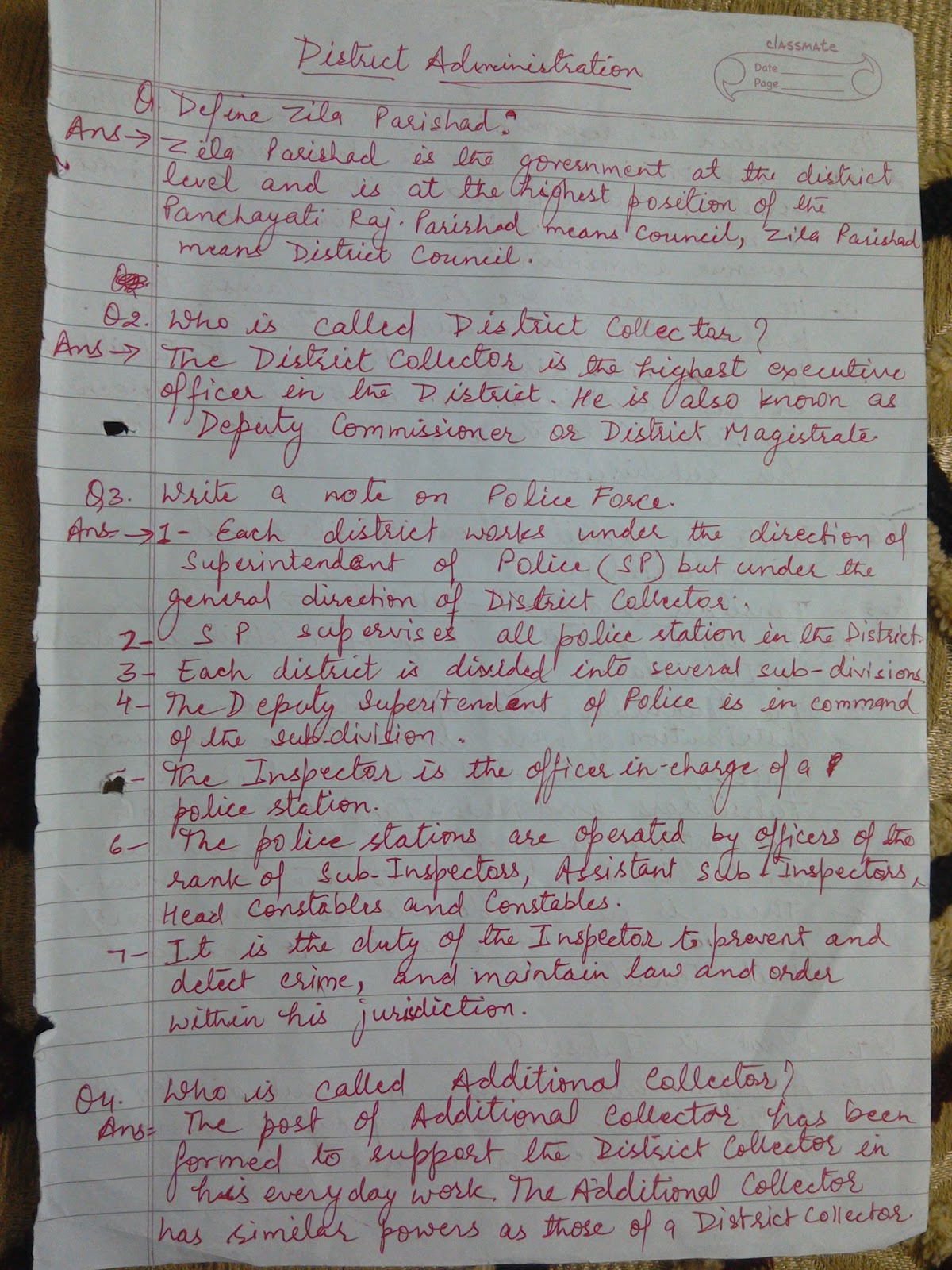
S.st---District Administration


Air- The Envelope of Life

Q.1  Do plants respire all the time? Compare the rate of respiration and rate of photosynthesis in a day.
Ans - Plants respire all the time because their cells need energy to stay alive, but plants can only photosynthesis when they are in the light. During day time photosynthesis is more in comparison to respiration, In dim light rate of respiration and photosynthesis are equal and at night respiration is dominant.

Q2. All living beings consume oxygen, it can lead to depletion of oxygen level. Yes or No? give reason for your answer.
Ans – No, because oxygen released during photosynthesis is much more than the oxygen consumed in respiration, the net oxygen is sufficient to support and sustain all life forms of life.

Q3. From where does the Saturn’s moon Dione got oxygen?
Ans – According to study, the oxygen atmosphere on this moon is most likely a product of space particles and surface ice.

Q4. Give reason: ‘Solid carbon dioxide is called as dry ice.’
Ans – On heating, solid carbon dioxide changes directly into gas getting into the liquid form. That’s is why solid carbon dioxide is called dry ice.

Q5. What are the advantages of CNG?
Ans – CNG (compressed natural gas) is a fuel used as a substitute for petrol and diesel. It is a clean alternative to these fuels. It is low in pollutants, economical and available in abundance.

Q6. Why do mountaineers have difficulty in breathing while climbing?
Ans - When we breathe in air at sea level, the atmospheric pressure causes oxygen to easily pass through lung membranes into the blood.  At high altitudes, the lower air pressure makes it more difficult for oxygen to enter our vascular systems.

Q7. Why do helium balloons floats in air?
Ans - The helium balloon displaces an amount of air (just like the empty bottle displaces an amount of water). As long as the helium plus theballoon is lighter than the air it displaces, the balloon will float in theair. It turns out that helium is a lot lighter than air.

Q8. Name the gas that is referred to as ‘laughing gas’.
Ans – Nitrous oxide (N2O) is known as laughing gas.

Q9. Draw a labeled diagram to show composition of air.
Ans -  


Q 10. Ravi while driving, switch off the engine of his car at red traffic light. What value is shown by Ravi.

Ans – He showed care for environment, responsible individual to avoid air and sound pollution and saving valuable fuel.

The Swiss Family robinson chapter 7

Comprehension Questions:

Q1 How did the family react on the narrator and his elder sons return?
Ans1.They were eagerly greeted by their family. When the first burst of happiness had subsided, they gave them an account of their endeavours on the wreck. The family expressed their surprise and joy at seeing so many useful
animals. Ernest and Jack ran to the boat and expressed their admiration of
the mast, the sail and the flag.

Q2 What did the narrator’s wife reflect on?
Ans 2 The narrator’s wife looked about in hope of finding a shady place where
they might retire from the heat of the sun but she found not a single tree. This
made her reflect a little seriously on the fact that it would be impossible to
remain in that place with no proper shelter except for the miserable tent.

Q3 What was the first task at hand?
Ans3 The first task at hand was to see if the timbers were long enough to reach
the other side of the river.

Q4 How did the narrator send the timber across the river?
Ans4 The narrator decided to attach one of the timbers to the tree’s trunk by a
strong cord which turned freely round the trunk. He fastened a s econd cord
to the other end of the timber, and tying a stone, flung it to the opposite
bank. Then he passed the river with a pulley. Passing the second cord
through the pulley and re crossing the river with this cord in hand, he
planned to harness the cow and the ass to the end of the cord. Next, he
drove the animals from the bank of the river. Fixing one end of the beam
firmly to the trunk of the tree, and then they drew along the other end,
gradually advancing over the river. It touched the other side and at length
become firm and fixed by its own weight.

The opening chapters of The Swiss Family Robinson introduce us to the six members of the Robinson family: Father, Mother, Franz, Fritz, Ernest, and Jack.We learn about these characters by what they say, what they do, and what other characters say about them. Careful study of these things will help you become familiar with the characters.Each of the statements below describes one of the six characters.

Fill in the blank with the name of the character that best fits the given description.

1. This character narrates the story.
2. This character comes up with the idea of making swimming belts to escape the ship.
3. This character is attacked by a lobster.
4. This character suggested using oyster shells for spoons. 5. These two characters first set out to explore the island.
6. This character was scared to touch a live monkey.
7. This character suggested making swimming jackets for the animals.

8. This character cooked for the family and encouraged them on all occasions.

Tuesday, December 1, 2015

S.st Notes----- Deccan and South Indian Kingdoms

1. · For how many years did the Satavahanas rule?
300 years
2. · What were they also known as?
Andhras
3. · Which inscriptions tell us about the reign of GautamiputraAtakarni?
Nashik and Nanaghad
4. · Who was the seventeenth king of the Satavahana dynasty?
What was he famous for?
Hala- famous for his book Gathasaptasati
5. · Who defeated Pulakesin II?
Narasimhavarman I
6. · Who was the successor of Pulakesin II?
Vikramaditya
7. What is literature?
Written works, especially those considered of superior or lasting artistic merit.
8. What was Sangam?
An assembly of Tamil poets held under the patronage of the kings.
9. · How many Sangams were there in all?
Three
10.            · Where was the first Sangam held?
Madurai
11.             · Where were the second and third Sangam held?
Kapadapuram and third at Madurai.
12.            · Which dynasties ruled the South India during the Sangam Age?
The Cheras,the Cholas, the Pandyas.
13.        What was the capital of Cheras?
Tiruvanchikulam
14.        · Which items were traded?
Spices, sandalwood and ivory.
15.        Where did the Pandyas rule?
Present day Tamil Nadu.
16.        · Where did the Cheras rule?
Over the modern parts of modern Kerala.
17.        · How do we know about the socio- economic conditions of the Pandyas?
The Maduraikkanji written by mangudimauthanar describes the socio Economic conditions of the Pandyas)
18.        · What was the capital of the Pallavas?
Kanchipuram
19.        · Who was the last Pallava ruler?
Aparajitavarman
20.        · Who was the first ruler of the Pallavas?
Simhavishnu
21.        · What was the capital of Cheras?
Vanji
22.        What does Bhakti mean?
Bhakti means total surrender to God.
23.        · Name the famous sants of the Bahkti sect in South India.
Nayanars and Alvars
24.        · What do you know about Nayanars?
They were devotees of Lord Shiva and wrote poetry in the praise of Lord Shiva.
25.        · What do you know about Alvars?
They were worshippers of Lord Vishnu..
26.        · Name two ports that became the centres of foreign trade.
Puhar, Tondi, Korkai, Arikkamedu and Marakkanam.
27.        · How do we know that trade was carried with the Romans?
Roman coins were found in all parts of Tamil Nadu.
----------------------------------------------------------------------------------------
1.Who was the famous king of the Cholas? Why was he famous?
  Karikala- his military achievements made him the overload of the whole Tamil countrytrade and commerce flourished during his reign- he was responsible for the
reclamation of the forest lands and brought them under cultivation- built the
Kallanai dam across the river Kaveri.

2.What did the handicrafts during the Sangam period include?
Weaving, metal works, carpentry, ship building and making of ornaments using beads and stones
3.Explain about the economy during the Sangam Age.
·      Handicrafts of the Sangam period were popular.
·       Included weaving, metal works and carpentry, ship building and making of ornaments using beads and stones.
·      There was a great demand of these products as the external and internal trade was its peak during the sangam period.
4.Explain the different types of villages during the Sangam Age
Three types of villages :
Sabha
· consisted of brahmadeya villages or villages granted to Brahmanas
· Brahman owners enjoyed individual rights
· activities were carried out collectively
Nagaram
· villagers were traders and merchants
· they dominated the village
Ur
· typical village

· consists of farmers